



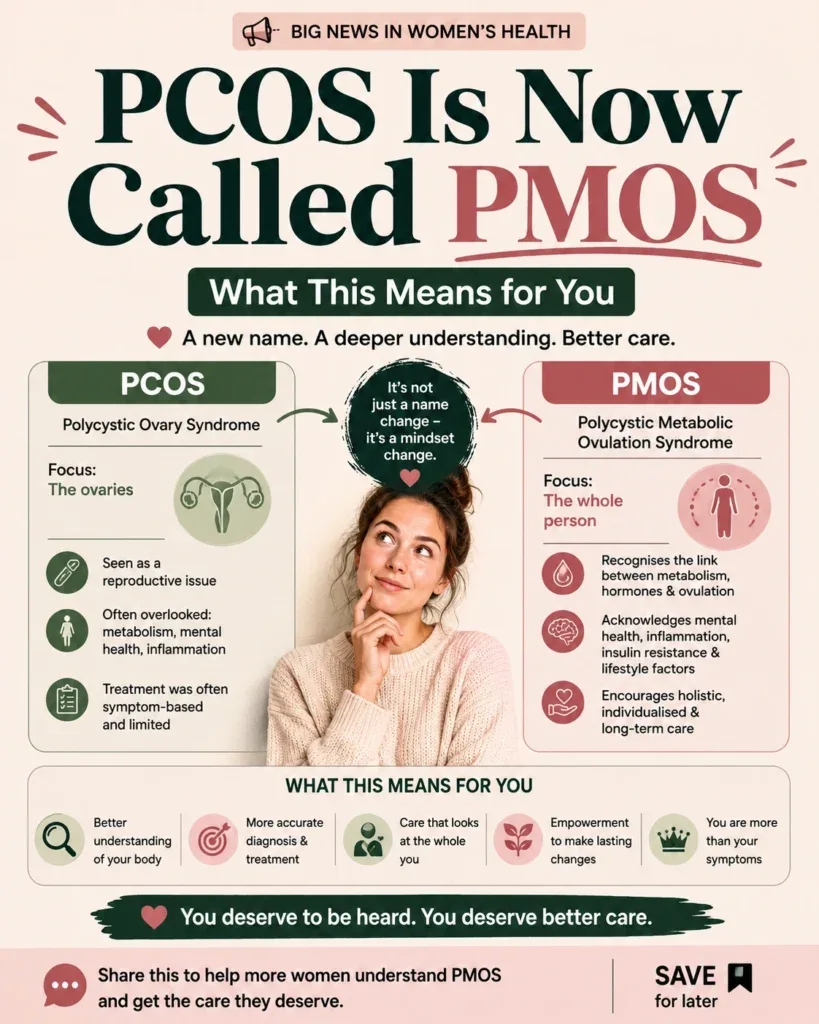
Something big just happened in women’s health. On 12 May 2026, experts officially renamed PCOS. The condition is now called Polyendocrine Metabolic Ovarian Syndrome, or PMOS. This is not just a new label. It reflects a far deeper understanding of what this condition really is. And it matters for every woman who has it.
Key Points at a Glance:
- PCOS has been officially renamed PMOS as of May 2026
- The new name was published in The Lancet, one of the world’s top medical journals
- Over 170 million women worldwide are affected — that is 1 in 8
- The old name caused confusion, delayed diagnosis, and poor care
- PMOS recognises the full impact: hormones, metabolism, mental health, and more
- Clinical guidelines and disease classifications will be updated globally
Why Did the Name Change?
The old name, Polycystic Ovary Syndrome, was misleading. It made people — including doctors — focus on ovarian cysts. But here is the truth: many women with this condition do not have cysts at all.
The word “polycystic” comes from “many cysts.” This led to missed diagnoses. Women without visible cysts were often told they did not have PCOS, even when they had all the other signs. This was wrong. And it caused real harm.
Research also showed the condition goes far beyond the ovaries. It affects the endocrine system (your hormones), your metabolism, your skin, your weight, your mood, and your heart health. The old name simply did not reflect this.
Professor Helena Teede of Monash University led the name change process. She said the condition was being reduced to a misunderstanding about cysts, which caused missed diagnoses and inadequate treatment for millions of women.
What Does PMOS Actually Mean?
Let us break down the new name:
- Polyendocrine — means the condition affects multiple hormone-producing glands, not just the ovaries
- Metabolic — recognises that insulin resistance, weight changes, and metabolic health are central features
- Ovarian Syndrome — keeps the connection to the ovaries and reproductive health
Together, the name paints a much clearer picture. PMOS is a complex, long-term hormonal disorder that touches nearly every system in the body. It is not just a gynaecological issue. It is a whole-body condition.
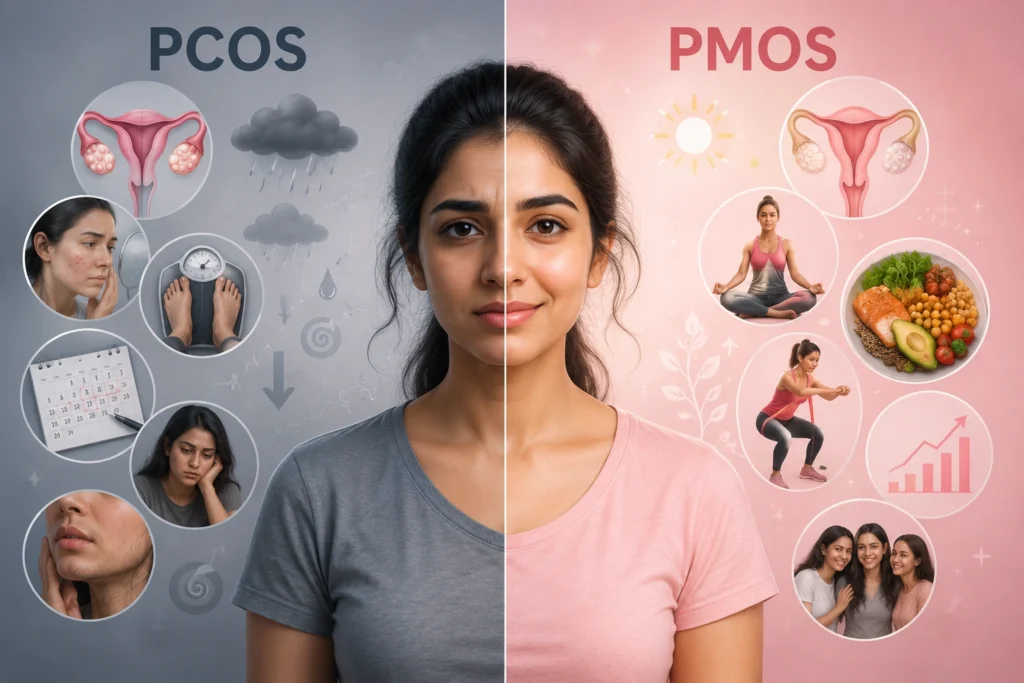
PCOS vs PMOS: What’s Actually Different
PMOS is not a new or different condition from PCOS. The name changed to better reflect that the condition involves hormonal and metabolic factors across the whole body, rather than being defined mainly by the ovaries. This matters because the old name led some patients to focus only on ovarian symptoms, while PMOS care looks at the fuller picture, including metabolic health, skin, weight, and emotional wellbeing alongside the reproductive symptoms. Diagnostic criteria, blood tests, and treatment approaches remain the same as they were under the name PCOS.
PCOS vs PMOS: What Changed and What It Means for Patients
| Feature | PCOS (Old Name) | PMOS (New Name) |
| Full Name | Polycystic Ovary Syndrome | Polyendocrine Metabolic Ovarian Syndrome |
| Core Focus | Ovarian cysts | Hormonal & metabolic system |
| Cysts Accurate? | No — many patients have none | Not part of the name |
| Recognises Insulin Resistance? | Poorly | Yes — central to diagnosis |
| Covers Mental Health? | Rarely | Yes — included in scope |
| Reflects Weight & Metabolism? | No | Yes — explicitly |
| Recognises Skin/Hair Issues? | Partially | Yes — as endocrine features |
| Research Funding Access? | Limited — gynaecology only | Broader — multi-system |
| ICD Classification Update? | Not yet | In progress globally |
| Led By | — | 56 global patient & clinical orgs |
| Published In | — | The Lancet, May 2026 |
How Was the Name Change Decided?
This was not a quick decision. It took 14 years of global collaboration. More than 14,000 women and healthcare professionals from every part of the world took part in surveys. Over 56 patient and professional organisations joined the process.
The process used rigorous scientific methods, including:
- Global surveys with 14,360 patients and health professionals
- Modified Delphi methods — a structured way to reach expert consensus
- Nominal group technique workshops to review and debate the options
- Engagement from all world regions, ensuring this was truly global
The result was clear. Patients and clinicians agreed: PMOS better represents what the condition truly is. The new name was also presented at the European Congress of Endocrinology in Prague in May 2026.
What Are the Symptoms of PMOS?
The symptoms remain the same. Only the name has changed. Common signs include:
- Irregular or absent periods
- Excess hair on the face, chest, or back (hirsutism)
- Acne or oily skin
- Thinning hair or hair loss from the scalp
- Weight gain or loss, especially around the abdomen
- Fatigue and low energy
- Anxiety, depression, or mood changes
- Insulin resistance or higher blood sugar levels
- Difficulty getting pregnant
Not every woman has all of these. PMOS presents differently in different people. That is exactly why the old name which focused only on cysts failed so many women.
How PMOS Is Diagnosed
A PMOS diagnosis (the same criteria used for PCOS) requires meeting at least two of three features: irregular or absent periods, signs of excess androgens such as acne or excess hair growth or a blood test showing raised androgen levels, and polycystic-appearing ovaries on an ultrasound. Nothing about how the condition is diagnosed has changed with the name update a diagnosis made under the name PCOS remains valid, and the same tests and criteria are used going forward under the name PMOS.
Does This Change My Diagnosis or Treatment?
No — your diagnosis remains valid. If you were diagnosed with PCOS, you now have PMOS. Nothing about your health history changes. You do not need a new diagnosis.
However, what will change over time is the way healthcare professionals approach the condition. The renaming signals a shift toward:
- Earlier diagnosis, even without visible cysts
- Broader testing — including metabolic and cardiovascular checks
- Better mental health support as a standard part of care
- More research funding, since the condition now sits across multiple medical specialities
- Updated international disease classification codes (ICD updates in progress)
At Well Women Clinic, we have always taken a whole-body approach to women’s hormonal health. The renaming to PMOS aligns closely with how we already work looking at the full picture, not just one aspect of a woman’s health.
Why This Matters for Women in the UK
In the UK, PCOS — now PMOS — is one of the most common hormonal conditions in women of reproductive age. Many women wait years before getting a correct diagnosis. Some are dismissed when they do not have visible cysts on a scan. Others are told to simply “lose weight” without addressing the underlying hormonal imbalance.
This renaming should push UK healthcare systems to:
- Train GPs and specialists on the broader definition of PMOS
- Update NICE guidelines to include metabolic and mental health markers
- Reduce the average time to diagnosis, which is currently around 2 years for many women
- Ensure women receive care from endocrinologists, not only gynaecologists
What This Means for Patients in the UK
If you already have a PCOS diagnosis, no new action is required because of the name change. Medical records, prescriptions, and test results are likely to still show PCOS for some time while the transition takes place, and both names may appear together during this period. If you have symptoms but have not yet been diagnosed, the same route applies as before starting with a GP or gynaecologist who can arrange the relevant blood tests and, where needed, an ultrasound.
Frequently Asked Questions About PMOS
Is PCOS and PMOS the same condition?
Yes. PMOS is the new official name for PCOS. The condition itself has not changed. Only the name has been updated to better describe what the condition actually involves.
Do I need to tell my doctor about the name change?
Your doctor should already be aware. However, if you are seeing a new specialist, it is helpful to mention both names. Say you have been diagnosed with PCOS, now called PMOS.
Does PMOS only affect the ovaries?
No. PMOS is a multi-system condition. It affects the endocrine system, metabolism, cardiovascular health, skin, hair, fertility, and mental health. The new name reflects this wider impact.
Can you have PMOS without ovarian cysts?
Yes, absolutely. In fact, research has confirmed there is no increase in abnormal ovarian cysts in women with this condition. Many women with PMOS do not have cysts at all. This was one of the biggest problems with the old name.
Will my medication change?
Not immediately. The name change is a first step. Clinical guidelines will be updated over time. If you are concerned about your current treatment plan, speak to a specialist.
How Well Women Clinic Can Help
At Well Women Clinic in London, Mr Nilesh Agarwal and our team specialise in complex women’s hormonal conditions, including PMOS. We take a thorough, personalised approach to every patient.
We offer:
- Comprehensive PMOS assessment — hormonal, metabolic, and gynaecological
- Blood tests including insulin levels, testosterone, and LH/FSH
- Ultrasound scanning interpreted in full clinical context
- Tailored treatment plans covering cycles, weight, skin, and fertility
- Support for emotional and mental wellbeing as part of your care
- Ongoing management and follow-up at our London clinics
If you think you may have PMOS, or if you have been diagnosed with PCOS and want a thorough review, we are here to help. You deserve care that sees the whole picture.
Many women who come to us with PMOS also mention symptoms like heavy periods with large blood clots, and we factor this into the wider assessment rather than treating it as a separate issue. We also support emotional and mental wellbeing as part of your care, with ongoing management and follow-up at our London clinics.
Dr Nilesh Agarwal helps you understand what the shift from PCOS to PMOS means, and what it could mean for your diagnosis and care. (Last updated: July 2026)
The Bottom Line
PCOS is now PMOS. The name has changed. The science behind it has grown. And the care women receive should grow with it.
For too long, women with this condition were misunderstood, misdiagnosed, and undertreated. The new name — Polyendocrine Metabolic Ovarian Syndrome — is a step toward fixing that. It tells the truth about what this condition is.
If you or someone you know has been affected, share this article. Knowledge is the first step toward better care.
Sources
Teede HJ et al. Polyendocrine metabolic ovarian syndrome, the new name for polycystic ovary syndrome: a multistep global consensus process. The Lancet. 2026. DOI: 10.1016/S0140-6736(26)00717-8
Endocrine Society Press Release. Polyendocrine Metabolic Ovarian Syndrome: New name to improve diagnosis and care. May 2026.
Monash University / Monash Centre for Health Research & Implementation. May 2026.
FAQs
What is the new name for PCOS?
PCOS has been renamed polyendocrine metabolic ovarian syndrome, or PMOS. The condition itself and its diagnosis have not changed, only the terminology.
Is PMOS the same as PCOS?
Yes. PMOS and PCOS refer to the same condition. The name was updated to better reflect the hormonal and metabolic nature of the condition, but the diagnostic criteria and treatment approach remain the same.
Do I need a new diagnosis if I already have PCOS?
No. An existing PCOS diagnosis remains valid under the name PMOS. No new tests or action are required purely because of the name change.
How is PMOS diagnosed?
PMOS is diagnosed using the same criteria as PCOS meeting at least two of three features: irregular periods, signs of excess androgens, and polycystic-appearing ovaries on ultrasound.
What is the best workout for PCOS?
The best workout for PCOS combines moderate-intensity cardio, strength training, and flexibility exercises. Activities such as brisk walking, cycling, swimming, yoga, and resistance training can help improve insulin sensitivity, support healthy weight management, balance hormones, and reduce common PCOS symptoms. Beginners should start gradually and aim for at least 150 minutes of moderate exercise per week while choosing activities they enjoy and can maintain consistently.