



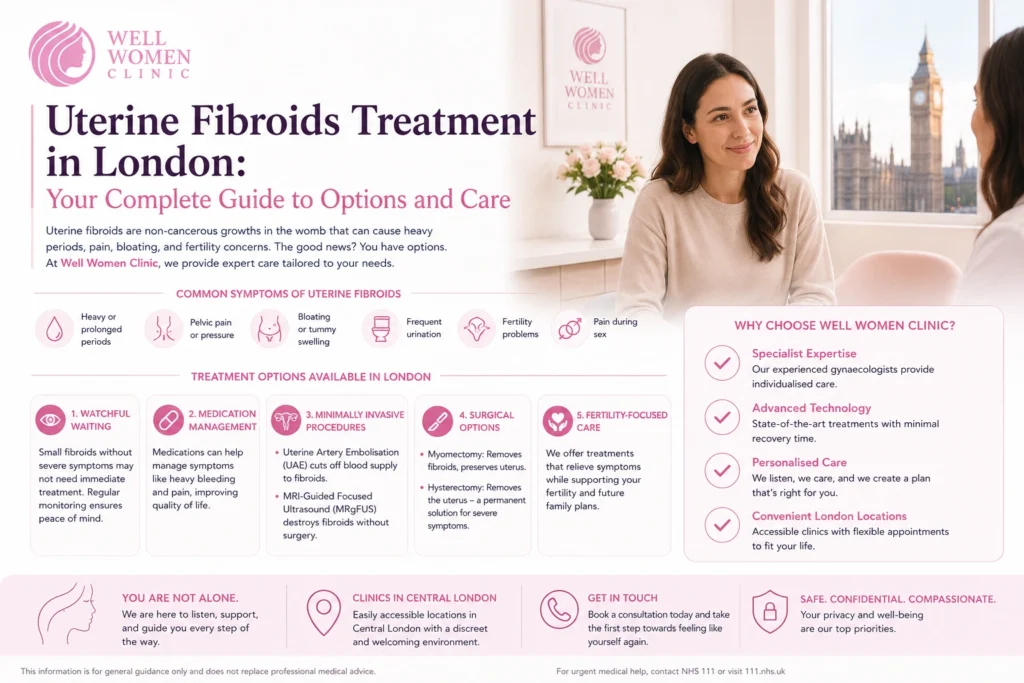
Uterine fibroids—benign tumours that develop in or around the uterus—affect up to one in three women of reproductive age. If you’ve been diagnosed with fibroids and live in London, you likely have questions: What treatment options exist? Do I need surgery? How will this affect my fertility? Will it impact my ability to have children? This guide explores uterine fibroids treatment in London, the range of approaches available, and how working with a specialist gynaecologist can help you make informed decisions about your reproductive health.
Understanding Uterine Fibroids
Fibroids are non-cancerous growths that develop from the smooth muscle tissue of the uterus. They vary dramatically in size—from tiny, asymptomatic nodules to large masses that distort the uterine shape. Some women never know they have fibroids; others experience debilitating symptoms that significantly impact quality of life.
The exact cause remains unclear, though hormonal factors (particularly oestrogen sensitivity) appear central. Risk factors include age (fibroids are more common in women aged 30–50), family history, obesity, and possibly diet. The good news: fibroids are not cancer and rarely become malignant.
Recognising Fibroids: Common Symptoms
Not all fibroids cause symptoms. Some are discovered incidentally on ultrasound during fertility assessment or routine scanning. But when fibroids do cause problems, symptoms include:
Heavy or prolonged menstrual bleeding—often the most distressing symptom, leading to anaemia and fatigue. Pelvic pain or pressure, particularly if fibroids are large or pressing on adjacent structures. Urinary frequency or difficulty emptying the bladder. Constipation or bowel pressure. In some cases, difficulty conceiving or recurrent miscarriage if fibroids distort the uterine cavity where an embryo implants.
If you’re experiencing any of these symptoms, uterine fibroids treatment in London is worth exploring—not to panic, but to gain clarity and access appropriate care.
Diagnosis: How Fibroids Are Identified
Your gynaecologist diagnoses fibroids through imaging. Ultrasound—either transabdominal (external) or transvaginal (internal)—is the first-line investigation. It clearly shows fibroid size, location (submucosal, intramural, or subserosal), and number. MRI provides more detailed information if surgery is being considered, as it maps fibroid location in relation to surrounding structures.
Hysteroscopy—a camera inserted through the cervix to visualise the uterine cavity—is useful if you have heavy bleeding or fibroids protruding into the cavity. This assessment determines which uterine fibroids treatment in London is most appropriate for your situation.
Uterine Fibroids Treatment in London: Your Options
Treatment depends on symptom severity, fibroid size and location, your desire for future pregnancy, and your personal preferences. A skilled private gynaecologist in London discusses all options before recommending a path forward.
If fibroids are asymptomatic or cause minimal symptoms, no treatment is necessary. Many fibroids don’t grow; some shrink, especially after menopause when oestrogen levels drop. Regular ultrasound monitoring ensures nothing changes unexpectedly. This approach suits women without symptoms who are unconcerned about fibroid presence.
Medical Management
Hormonal medications can reduce bleeding and sometimes shrink fibroids. Combined oral contraceptives regulate menstrual cycles and often decrease bleeding volume. Progestin-only methods (the mini-pill, implant, or intrauterine system like Mirena) are particularly effective for heavy periods; the Mirena IUD, in particular, significantly reduces menstrual bleeding in fibroid patients.
Tranexamic acid, a non-hormonal medication taken during menstruation, reduces bleeding by up to 50% without addressing the fibroid itself. It’s useful as a temporary measure or alongside other treatments.
GnRH agonists (leuprolide, goserelin) create a temporary menopausal state, shrinking fibroids but causing hot flushes and bone loss if used long-term. These are typically short-term bridges before surgery or for symptom relief before conception attempts.
Minimally Invasive Procedures
Uterine artery embolisation (UAE) blocks the blood supply to fibroids, causing them to shrink. It’s performed by an interventional radiologist under sedation; recovery takes 1–2 weeks. Success rates are high (70–90% symptom improvement), but some fibroids regrow within 5 years. UAE is contraindicated if you plan future pregnancy, as it may affect uterine blood supply.
MRI-guided focused ultrasound (MRgFUS) uses heat energy to destroy fibroid tissue without incisions. It’s newer, with limited long-term data, but shows promise for women seeking non-surgical options.
Surgical Options
Myomectomy—surgical removal of fibroids while preserving the uterus—is ideal for women desiring future pregnancy or wishing to retain their uterus. It can be performed via:
Laparoscopic myomectomy (minimally invasive keyhole surgery) for fibroids on the uterine surface or outside the uterus. Recovery is 1–2 weeks.
Hysteroscopic myomectomy (via the cervix) for fibroids protruding into the uterine cavity. It’s minimally invasive with rapid recovery but limited to certain fibroid types.
Open abdominal myomectomy (laparotomy) for large or numerous fibroids requiring a traditional surgical incision. Recovery is 4–6 weeks, but it allows removal of multiple large fibroids in one procedure.
Hysterectomy—surgical removal of the uterus—is the definitive treatment, eliminating fibroids entirely and preventing recurrence. It’s appropriate for women who’ve completed childbearing or don’t desire future pregnancy. It can be performed vaginally, laparoscopically, or via abdominal incision, depending on uterus size and complexity.
Why Choose a Private Gynaecologist in London for Fibroid Treatment
Uterine fibroids treatment in London through a private gynaecologist offers distinct advantages. You receive:
Comprehensive assessment. Extended consultation time allows detailed exploration of your symptoms, fertility plans, and treatment preferences—not a rushed NHS appointment.
Specialist expertise. A private gynaecologist with specific fibroid experience (like Dr. Nilesh Agarwal) understands nuanced treatment decisions and can tailor approaches to your individual circumstances.
Faster access. Rather than NHS waiting lists, private uterine fibroids treatment in London can begin within days or weeks, reducing prolonged suffering.
Integrated care. If fibroids affect fertility, your gynaecologist can coordinate fibroid treatment with fertility optimisation, contraception counselling, or other reproductive health needs—all within one trusting relationship.
Modern facilities and technique. Private clinics often access cutting-edge technology (advanced laparoscopic equipment, hysteroscopic instrumentation) enabling minimally invasive approaches with faster recovery.
Dr. Nilesh Agarwal’s Approach to Fibroid Treatment
Dr. Agarwal begins with thorough assessment: detailed history, comprehensive ultrasound or MRI imaging, and honest discussion of how fibroids impact your life. He presents all realistic options—from watchful waiting to surgery—with clear explanation of benefits, risks, and recovery for each.
If surgery is chosen, he uses minimally invasive techniques whenever possible, aiming for fastest recovery and best cosmetic outcomes. His approach balances symptom relief with fertility preservation, ensuring future pregnancy remains possible if desired.
Post-treatment follow-up monitors your recovery and addresses any concerns. If fibroids recur (as they do in 10–20% of myomectomy cases), he discusses next steps—repeat surgery, hysterectomy, or alternative approaches—tailored to your evolving needs.
Conclusion
Uterine fibroids treatment in London is highly successful, with numerous options suited to different situations. The key is early consultation with a specialist who listens, explains thoroughly, and partners with you in deciding the best path forward. A private gynaecologist in London can offer personalised assessment, faster access to care, and integrated support tailored to your fertility plans and long-term reproductive health goals
If you’re experiencing fibroid symptoms or have been diagnosed with fibroids, contact Well Women Clinic. Dr. Nilesh Agarwal will assess your situation, discuss uterine fibroids treatment options in London, and help you reclaim comfort, energy, and confidence in your reproductive health.